
Solutions · Access by request
Start with a decision. Scale into continuous intelligence.
You do not have to deploy a large enterprise system to begin. One important decision is enough, and the same layer extends from there into continuous monitoring and the organization's own processes.
How adoption works
Start with a decision.
Bring one difficult decision, investment, market question or risk. Mission Grey builds the external context, scenarios and recommendations around it.
Keep it under watch.
The assumptions and exposures behind that decision stay under watch, and recurring questions become trackers, indicators, scenarios, triggers and alerts.
- Continuous signals against your own exposure
- Scenarios that update as conditions move
- Thresholds, triggers and decision alerts
Make it part of the organization.
Shared dashboards, role‑specific applications, agents, APIs and workflows, built on the same intelligence layer rather than beside it.
- Role‑specific views on shared evidence
- Applications and dashboards around your decisions
- Agents and API into the systems you already run
- Decision ownership, actions and review, kept as organizational memory
One layer throughoutOne decision, then a standing watch that becomes continuous intelligence, then the organization's shared intelligence.
Step one · one decision
What the first engagement looks like.
You bring
One important decision, exposure, opportunity or question, plus the people who own it and relevant company context.
Mission Grey brings
The external intelligence, sources, models, analysis and expert input relevant to that question.
You receive
A decision‑ready situation view, impact and exposure analysis, scenarios and concrete recommendations that can be used in an executive or management discussion.
TimingA first version using standard Mission Grey data can typically be produced in about two weeks. Connecting proprietary data takes longer, and the schedule for agents and a customer dashboard follows your requirements and the systems involved.
The steps can be combined. The first conversation is about which step carries your question.
The closed loop
From intelligence to accountable action
Don't stop at the recommendation.
Under a standing watch, every decision runs the same chain, and it does not end at the recommendation. Mission Grey can keep a traceable record of the external development, the analysis, the decision, the owner, the action and the follow‑up. Ownership is named against the function that carries it.
01External change
What changed?
02Assessment
What does it mean for us?
03Scenarios
What could happen?
04Decision
What did we decide?
05Owner
Who owns the response?
06Action
What was done?
07Review
What happened next?
ReturnUpdated assumptions and monitoring
One chainWhat the organization decides can change what Mission Grey measures next.
The system can remember what the organization did about it.
Mission Grey can preserve that chain.
That record carries the organization through the moments where the context is usually lost: people change, a decision is revisited, assumptions need updating, or a similar development appears again.
What it produces is organizational learning rather than an archive.
Process, ownership and escalation
Technology is only part of the answer.
Mission Grey can also help establish the process around external intelligence.
What to watch
Which external developments matter?
What they affect
Which strategies, assumptions, assets and exposures?
Who owns them
Which executive or function is responsible?
When to escalate
Which signals or thresholds require attention?
How to decide
How does intelligence reach the right decision process?
How to follow through
How are decisions, owners, actions and outcomes reviewed?
External intelligence workshop
We can start by mapping the decisions, exposures, assumptions, monitoring priorities and ownership model that matter to your organization.
What it produces
- External intelligence map
- Priority decisions and exposures
- Key assumptions
- Priority scenarios
- Ownership model
- Monitoring priorities
- First Mission Grey use case
AOne clear decision
You already have a decision, exposure or question in front of you. Start with one decision and the first engagement built around it.
BNo first use case yet
External intelligence is fragmented across the organization and the right first use case is not yet defined. Start with the external intelligence workshop.
Both lead into the same Mission Grey implementation on the same intelligence layer.
Daily use
One layer, different responsibilities
How each function uses the same layer.
Top management
Is our strategy still based on the world that exists today?
Whether strategy and capital allocation still hold between planning cycles.
Sales
Where is demand moving before it appears in our pipeline?
Where customer economics, regulation and competition are moving.
Operations
What external development could affect our ability to deliver?
Which suppliers, sites and routes need a decision, and when.
Finance / treasury
Which external change is altering our economics?
When to hedge, refinance or review a counterparty.
Risk / compliance
Which emerging issue actually matters to us?
Which issue is material, and who owns it.
Strategy / investment
Which assumptions behind this investment are changing?
Whether to proceed, adjust or exit.
Public affairs / regulation
What is coming in regulation, and what does it mean for us?
Where to engage, and what to prepare for.
Where organizations use this, by decision context, is on Use cases.
Direct · Integrated · Guided
Mission Grey adapts to how your organization works.
Use the platform directly, connect it to the systems you already run, or work with Mission Grey experts. The three combine.
In practice
From external change to the action it forces
Intelligence you can work in, not only read.
Every step of the chain is held, so a change in the world arrives as a decision to take rather than as a headline to read.
01External change
An export control tightens around a specialty input, and the region that hosts the plant reprices industrial power.
02Business exposure
Two cleanroom lines run on that input, and the plant's energy cost sits inside a fixed‑price customer agreement.
03Affected process
Qualification of an alternate material, and the supply agreement whose renewal window is open now.
04Implication
Unit cost and line availability move together, and the exposure concentrates in one quarter rather than spreading across the year.
05Recommended action
Begin qualification, price the alternate input, and take the renewal to a decision while the window is still open.
An application built around one decision environment.
At the third step the layer carries applications and dashboards built around your organization: signals, scenarios, assumptions and decisions in one place.
Agents route what changed to the person who owns it.
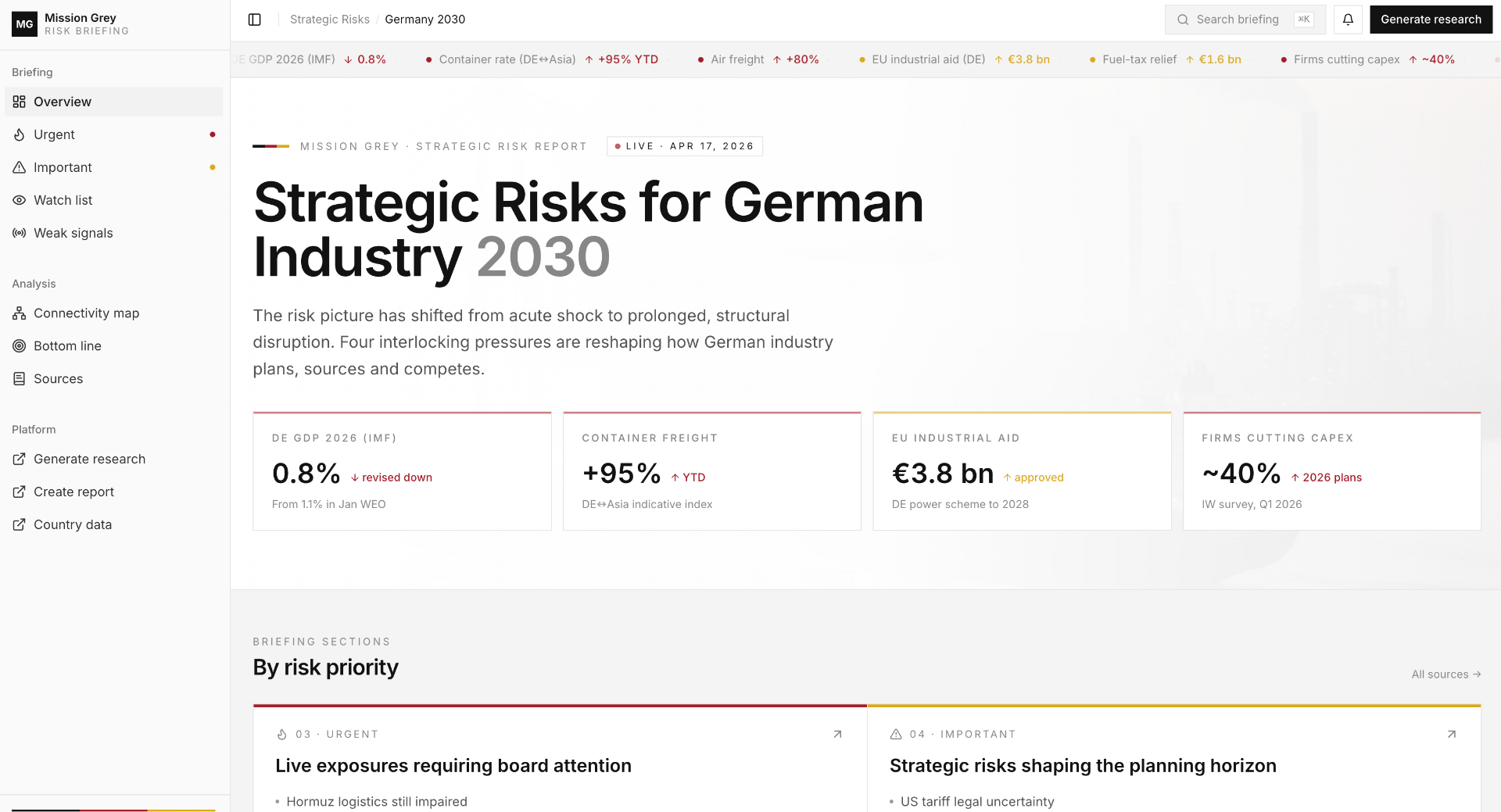
How the layer underneath is built is on Platform.
Quoted verbatim, names withheld
Trusted in practice.
“We stopped relying on static reports. Mission Grey provides signals that directly influence our decisions.”
Head of Strategy · Global Industrial
“Traditional stress testing is no longer sufficient. We need to evaluate real‑world scenarios and understand where model assumptions break down. Mission Grey enables that.”
Partner · Real Estate Portfolio Company
“We use Mission Grey to enhance client work: delivering more relevant insights and enabling continuous monitoring.”
Partner · Advisory Firm
Access
Find the right setup for your organization.
Tell us the decision in front of you, or the area where your external intelligence is fragmented. We will tell you which step carries it. Mission Grey is an enterprise platform; access is by request.
Request accessFor organizations ready to start working with Mission Grey.
See it on your decisionA short working session using a real question, exposure or opportunity from your organization.