
Markets
From Research to Decisions: What Cambridge Judge Business School Reveals About External Intelligence
The broader conclusion is straightforward. External volatility is no longer an exception; it is the operating environment. Companies that treat external intelligence as a core part of decision-making infrastructure will operate differently from those that do not.
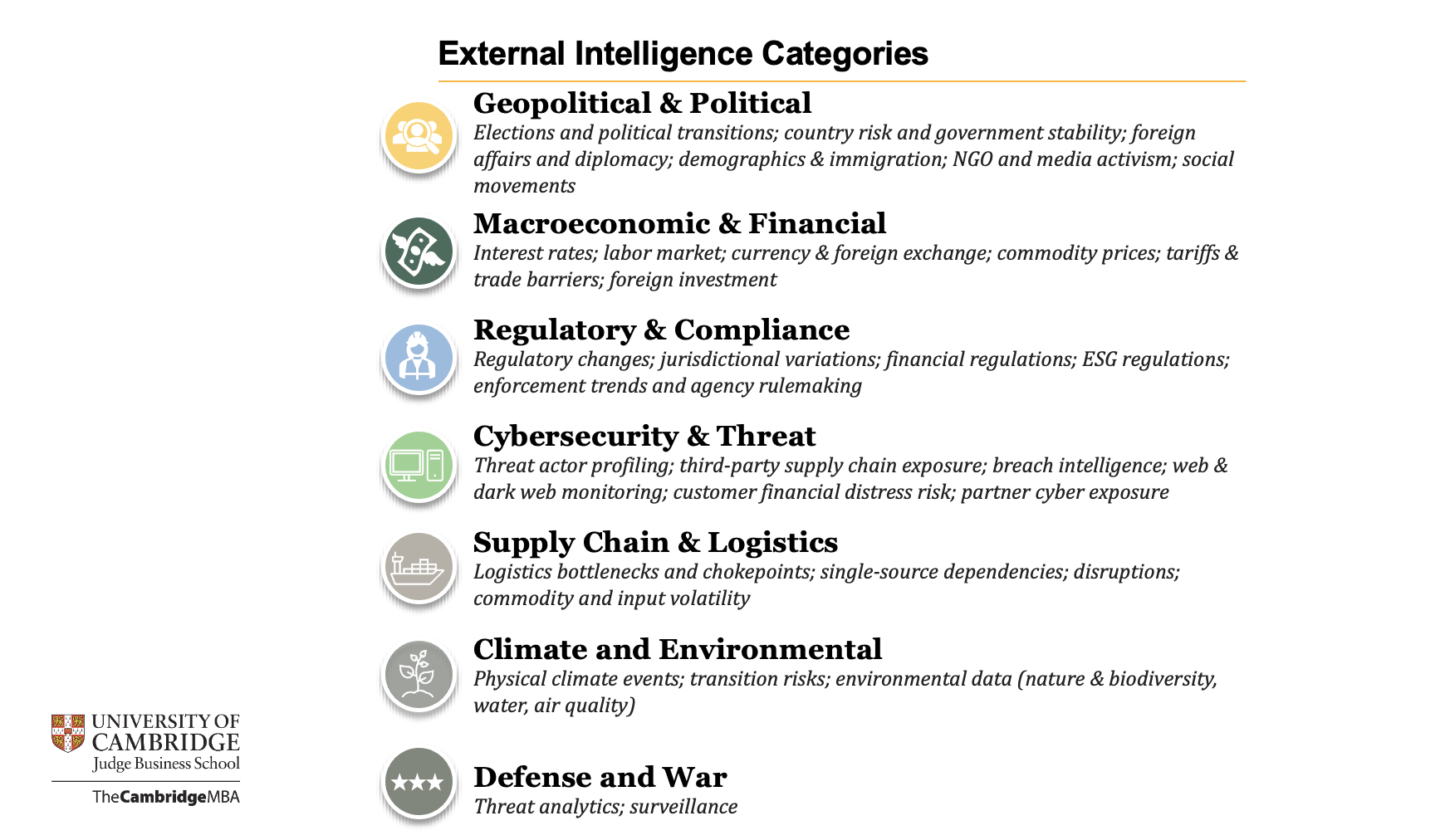
This insight builds on a joint effort between Mission Grey and the Cambridge Judge Business School, where the focus has been to analyze how companies actually use external intelligence and how this can be translated into practical models that improve real business decisions.
The collaboration combines academic rigor with operational reality. Instead of looking at external intelligence as a theoretical concept, the work examines where companies struggle in practice: how they monitor the world around them, how they interpret signals, and ultimately how they make decisions under uncertainty.
A clear pattern emerges. Companies are increasingly exposed to external forces, geopolitics, regulation, supply chains, and macroeconomic shifts, but their internal decision structures have not evolved at the same pace. External analysis is often fragmented across teams, based on static reports, or disconnected from actual decision-making. The result is not lack of data, but lack of clarity.
This becomes very concrete in situations that matter most. When a company expands into a new market, it must navigate regulatory differences, political dynamics, and local uncertainties. Without a structured way to monitor and compare these factors, decisions are slow and often based on incomplete assumptions. In financial institutions, geopolitical risk is now a core concern, yet scenario analysis is frequently inconsistent across teams, leading to misaligned decisions and delayed responses. In industrial sectors, supply chains stretch across regions with complex risk profiles, but visibility often stops at the first tier, leaving companies exposed to disruptions they cannot anticipate.
The research highlights a key insight: companies are not looking for more information, they are looking for decision confidence. They need a way to translate external signals into clear, comparable scenarios that support faster and more defensible choices.
This is where the combination of academic structure and practical application becomes critical. The cooperation between Mission Grey and the Cambridge Judge Business School – via its Global Consulting Project – is focused precisely on this point, developing models that turn external intelligence into something usable in everyday business decisions. Not just analysis, but structured inputs that can be embedded into workflows, align teams, and support management at the moment decisions are made.
When this is done well, the impact is tangible. Companies can move faster in market entry decisions, price risk more accurately, anticipate disruptions earlier, and communicate their choices with greater credibility to stakeholders. These are not abstract benefits; they directly affect growth, resilience, and competitive positioning.
The broader conclusion is straightforward. External volatility is no longer an exception; it is the operating environment. Companies that treat external intelligence as a core part of decision-making infrastructure will operate differently from those that do not.
Not because they have more data, but because they can act on it with clarity.
All insights Mission Grey · External intelligence